In my previous journal entry, I wrote about the quiet role books play in my design process. They rarely mark the beginning of an idea, but they often become companions as that idea develops. There isn't one book I reach for every time I design. Depending on what I'm exploring, I find myself returning to different shelves. Some books help me think about garment construction, others encourage me to explore texture or revisit knitting traditions. More recently, I've begun building a small collection of books on machine knitting as I learn a new way of working. And there are also books that simply remind me to slow down and look more carefully.
This isn't an exhaustive list, nor is it intended as a ranking of my favourite knitting books. Rather, it's a selection that illustrates the different roles books can play throughout the creative process. Which one I reach for depends entirely on the question I'm trying to answer.
Garment construction
Some books help me think about how a garment comes together. I enjoy studying different approaches to shaping, necklines, sleeves, and finishing details, not because I want to reproduce a particular garment, but because I find it interesting to understand how another designer has solved a construction. I tend to be drawn to relatively simple designs that provide a clear foundation and leave room for interpretation and adaptation.
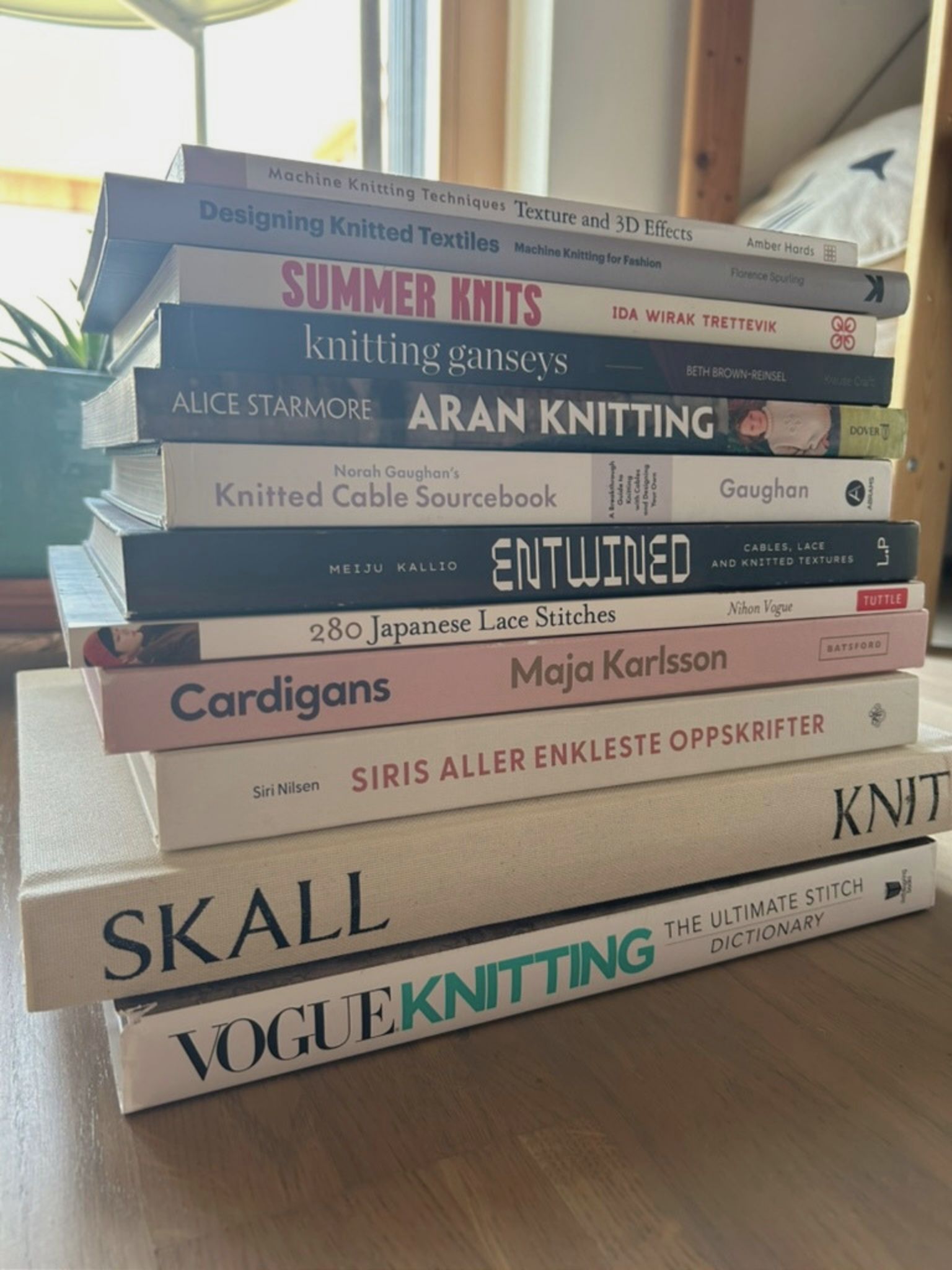
Three books I often return to are Siris aller enkleste oppskrifter by Siri Nilsen (available in Norwegian only), Cardigans by Maja Karlsson, and Summer Knits by Ida Wirak Trettevik. Although each has its own style, they all share a thoughtful approach to construction that I enjoy revisiting.
Texture and stitch exploration
At other times, construction isn't the question at all. Instead, I'm interested in the surface of the fabric. How does a stitch pattern change when it's worked at a different scale? What happens when two textures meet? How can a small detail influence the character of an entire garment? For these kinds of questions, I often reach for Vogue® Knitting: The Ultimate Stitch Dictionary, 280 Japanese Lace Stitches, and The Knitted Cable Sourcebook by Norah Gaughan. I rarely open these books looking for a stitch pattern to use exactly as it appears. More often, I'm searching for a rhythm, a texture, or a small detail that can evolve into something new.
Knitting traditions
Sometimes the answer isn't found in a contemporary pattern book at all. Looking at traditional garments and regional stitch patterns reminds me that knitting is part of a much longer story. Understanding where techniques come from and how they were originally used adds another layer to the design process. Aran Knitting by Alice Starmore and Knitting Ganseys by Beth Brown-Reinsel are books I return to not only for their patterns, but also for the history and context they provide. They encourage me to look beyond individual motifs and appreciate the traditions they belong to.
Machine knitting
More recently, another shelf has begun to grow. As I explore machine knitting, I've started collecting books that help me understand both the technical possibilities of the machine and the different ways designers approach it. At the moment, I most often return to Designing Knitted Textiles by Florence Spurling and Texture and 3D Effects by Amber Hards. They have become valuable references as I experiment with new techniques and gradually develop my own way of working with the machine.
Design and visual inspiration
Not every knitting book on my shelf is there to answer a technical question. Some simply invite me to slow down. They remind me that photography, colour, texture, and presentation shape how we experience knitwear just as much as the stitches themselves. Two books I particularly enjoy revisiting are Entwined by Meiju Kallio and Knit by Skall Studio. I don't open them looking for technical solutions. Instead, they encourage a slower way of looking and often leave me with new ideas or a different perspective.
Looking across these shelves, I'm reminded that books rarely give me answers. Instead, they help me ask better questions. Whether I'm thinking about construction, texture, knitting traditions, learning a new technique, or simply looking for a fresh perspective, they remain quiet companions throughout my design process.