Most designs begin long before yarn is chosen and stitches are cast on. They often start with an observation. A detail noticed during a walk, a pattern in nature, the rhythm of a façade, the way light moves across a surface. These moments rarely arrive as complete ideas. More often, they leave behind a feeling, a question, or a direction worth following.
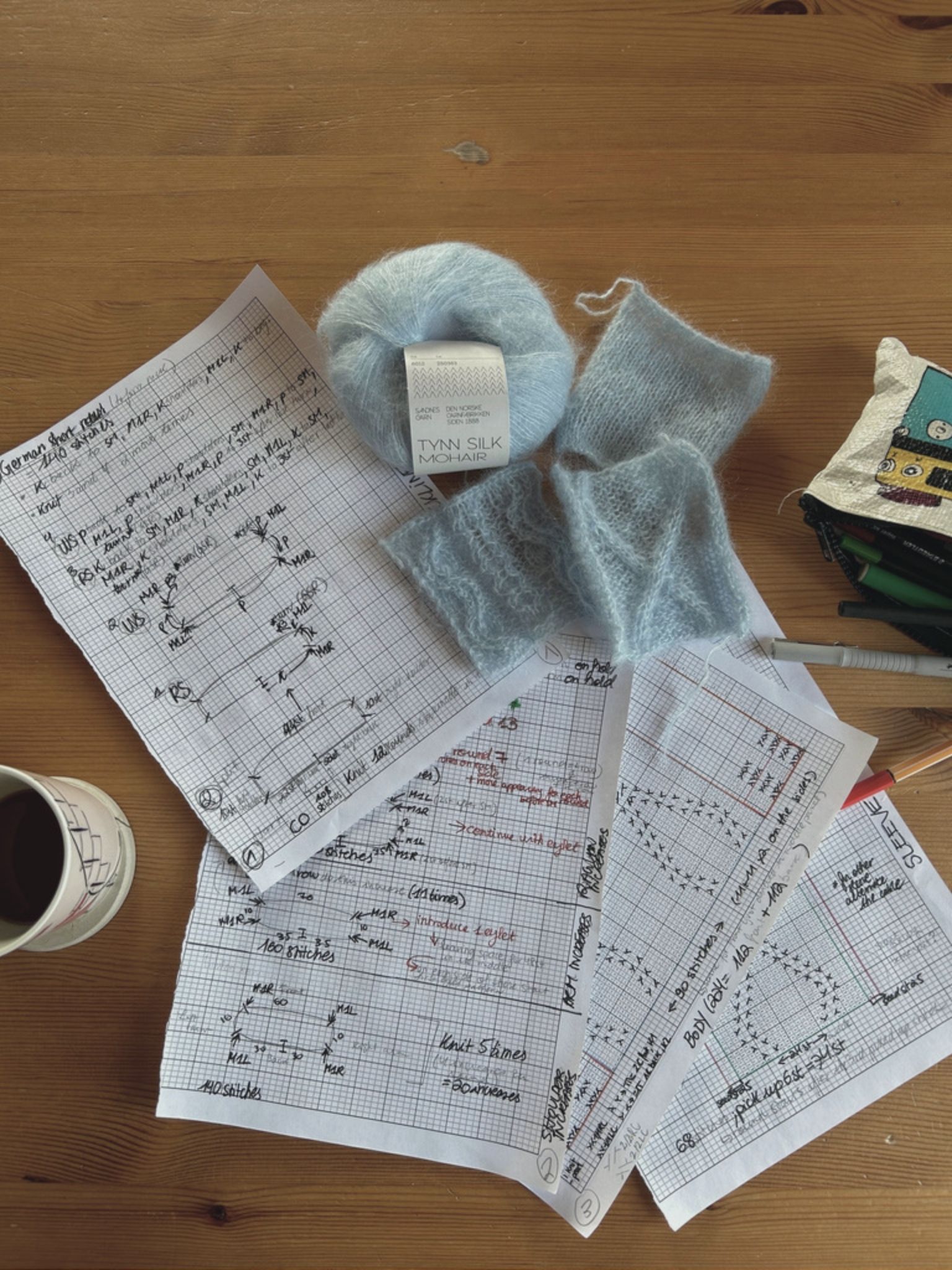
The sketchbook is usually the first place where that direction begins to take shape. Lines appear. Notes gather in the margins. Questions emerge alongside possibilities. What kind of garment could carry this idea? What construction would support it? What textures belong to it? This is often the moment when I begin reaching for books. Not because I am looking for a design to recreate, but because I am looking for a conversation.
Over the years, a small collection of knitting books has slowly found its way onto my shelves. Some focus on construction, others on stitch patterns, knitting traditions, or textile history. Certain volumes return to my hands again and again, particularly when a new design is beginning to form. What draws me to these books is rarely the finished garments themselves. Instead, I find myself studying the choices behind them. The way a shoulder is shaped. The relationship between a construction method and a stitch pattern. The balance between simplicity and detail. There are countless ways to build a sweater, and I continue to be fascinated by how different designers approach the same challenge. The same curiosity leads me toward books on Aran knitting, gansey traditions, and textile history. Understanding where a pattern comes from, how it evolved, and what it once meant often adds another layer to the design process. A motif becomes more than decoration. It becomes part of a larger story.
Yet inspiration is not the same as imitation. For me, inspiration begins with observation. When a particular detail catches my attention, I tend to stay with it for a while. I look at it from different angles. I consider its construction, its purpose, its relationship to the whole garment. Sometimes that detail finds its way into my own work in a transformed form. Sometimes it simply opens a door toward an entirely different idea. Either way, the goal is not to reproduce what already exists. The goal is to understand it deeply enough that it leads somewhere new.
Books are particularly valuable in this process because they invite a slower pace of observation. I also use digital tools. Pinterest, online archives, and other resources can be valuable companions. Yet I often find myself returning to books because they create a different kind of space. A book has edges. It has a beginning, a middle, and an end. The internet rarely does. Online, one image leads to another, and another after that. Inspiration becomes endless. While this abundance can be exciting, it can also make it difficult to remain with a single idea long enough for it to develop. The mind follows every path at once.
Books feel different. They allow me to return to the photographs I took during a walk, revisit an early sketch, compare yarns, and gradually build connections between ideas. They create a quieter environment in which thoughts can unfold at their own pace. Perhaps that is what I value most. Not the information itself, but the space. Space to observe more carefully. Space to think more slowly. Space to develop an idea without feeling pulled in ten directions at once. Because a design is rarely born in a single moment. It emerges gradually through observation, sketching, swatching, questioning, and making. Books become part of that journey, alongside notebooks, materials, walks, photographs, and conversations.
Eventually, however, there comes a point when the books must be closed. The sketches are on the page. The yarn has been chosen. The first stitches are on the needles. At that stage, the design must begin speaking for itself. The books remain nearby, waiting patiently on the shelf should I need them again. But the work now belongs to the garment, and to the quiet process of bringing an idea into form.
In a future journal entry, I will share some of the knitting books that have accompanied me most often along the way, and why they continue to return to my hands whenever a new design begins.